


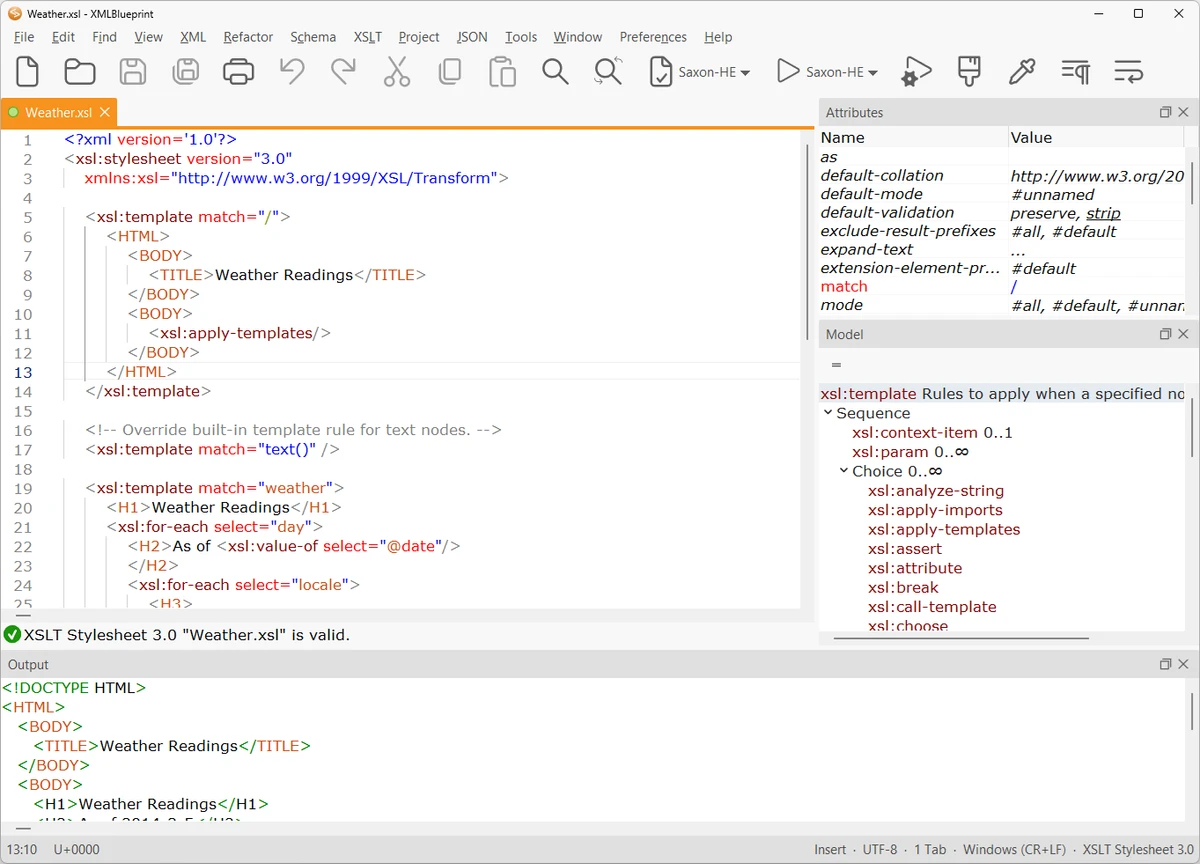

XMLBlueprint is a feature-rich XML editor designed for both professional developers and advanced home users who work with structured data formats. It provides extensive support for XML-related standards including DTD, Relax NG, Schematron, XSD, XPath (1.0–3.1), and XSLT (1.0–3.0), making it a comprehensive environment for XML development and validation.
One of its key strengths is the ability to handle extremely large XML files, including documents exceeding 1GB in size, without losing performance or editing capabilities. The software is built to support validation as you type, helping users detect errors early through integrated schema checking.
XMLBlueprint also includes tools for XML generation, refactoring, formatting, and schema conversion, allowing users to work efficiently across complex XML structures. Its support for remote editing via FTPS, SFTP, and WebDAV adds flexibility for developers working with distributed systems or server-based XML files.
Features of XMLBlueprint
- Full support for DTD, XSD, Relax NG, Schematron, and XML Schema validation
- XPath support (1.0, 2.0, 3.1) and XSLT support (1.0, 2.0, 3.0)
- Real-time XML validation while typing
- Handles extremely large XML files (1GB+)
- XML refactoring tools for structural changes
- XML formatting and indentation customization
- XML generation from XSD, DTD, or Relax NG schemas
- Convert CSV and Excel files to XML
- XML tag completion with IntelliSense-style suggestions
- Outline view and breadcrumb navigation for XML structure
- Remote file editing via FTPS, SFTP, and WebDAV
- Syntax highlighting for XML, HTML, CSS, Java, and JavaScript
- XML catalogs for faster schema access
Interface and Usability
XMLBlueprint is designed with a structured, developer-focused interface that emphasizes productivity when working with complex XML documents. Features like outline view, breadcrumbs, and folding help users navigate large and deeply nested XML structures more efficiently.
The editor provides real-time validation and intelligent tag completion, reducing the likelihood of structural errors. While the tool is powerful and feature-rich, its interface remains organized, allowing users to access advanced XML functions without overwhelming navigation complexity.
Who Should Use XMLBlueprint?
This software is best suited for XML developers, data engineers, and technical professionals who frequently work with structured data formats such as XML, XSD, and XSLT. It is also useful for users who need to process large XML files or perform schema-driven data transformations.
Conclusion
XMLBlueprint stands out as a powerful XML development environment with deep support for modern XML standards and large-scale file handling. Its combination of validation tools, refactoring features, and schema-based assistance makes it highly effective for complex XML workflows.


