


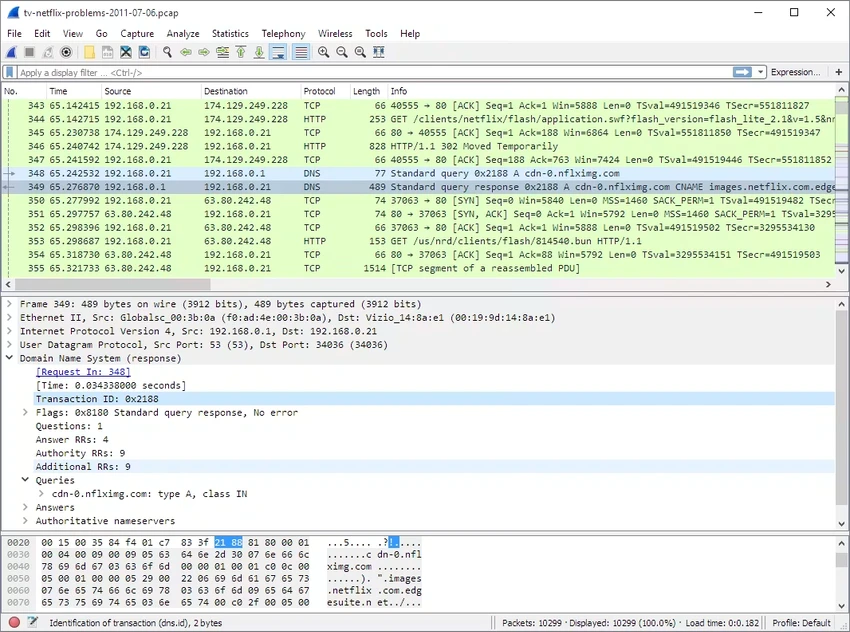

Wireshark is a powerful network protocol analyzer that allows users to capture and inspect data traveling across a live network or stored in previously captured files. Originally known as Ethereal, the software has become one of the most widely used tools for examining network communications, troubleshooting connectivity issues, and analyzing packet-level data.
The application provides an interactive environment where users can browse captured network traffic and view both summary information and detailed packet data. Wireshark supports advanced filtering capabilities, allowing users to focus on specific types of traffic, protocols, or communication patterns. It also includes features for viewing reconstructed TCP streams, helping users understand the flow of network sessions.
Wireshark can open capture files from many different sources and formats, including tcpdump (libpcap), NAI Sniffer, Sniffer Pro, NetXray, snoop, Microsoft Network Monitor, Novell LANalyzer, RADCOM WAN/LAN Analyzer, and other network capture tools. It can also work with compressed capture files, including those compressed with gzip.
Designed for detailed network analysis, Wireshark is commonly used by network administrators, security professionals, developers, and technical users who need visibility into network activity. Its extensive protocol support and detailed packet inspection capabilities make it suitable for diagnosing network problems, studying communication behavior, and analyzing captured traffic.
Features of Wireshark
- Capture and inspect data from live networks
- Analyze previously saved packet capture files
- View detailed information for individual packets
- Provides summary and detailed packet views
- Includes advanced display filtering capabilities
- Supports TCP session stream reconstruction
- Reads capture files from various network analysis tools
- Supports compressed capture files using gzip
- Designed for detailed network protocol analysis
Interface and Usability
Wireshark provides a detailed interface built around packet capture and analysis workflows. The application displays captured traffic in an interactive format, allowing users to browse packets and examine information at different levels of detail. The filtering system is one of the most important usability features, helping users narrow large amounts of network data into specific results. For experienced users, this makes it easier to investigate particular protocols, connections, or communication events.
Because Wireshark exposes low-level network information, the software has a learning curve for beginners. Users who are familiar with networking concepts will find its detailed packet views and analysis tools especially valuable.
Overall, Wireshark is designed as a professional-grade analysis tool rather than a simple network monitoring application.
Who Should Use Wireshark?
- Network administrators troubleshooting connections
- Security professionals analyzing network traffic
- Developers debugging network-based applications
- IT professionals investigating communication issues
- Students and researchers learning network protocols
Conclusion
Wireshark is a comprehensive network protocol analyzer that provides deep insight into network traffic and packet communication. Its ability to capture live data, analyze saved files, and display detailed protocol information makes it an essential tool for many networking and security professionals.
Although the software requires some technical knowledge, its powerful analysis features make it valuable for troubleshooting, learning, and investigating network behavior. If you need a professional packet analysis solution for examining network traffic, Wireshark is a tool worth exploring.


