


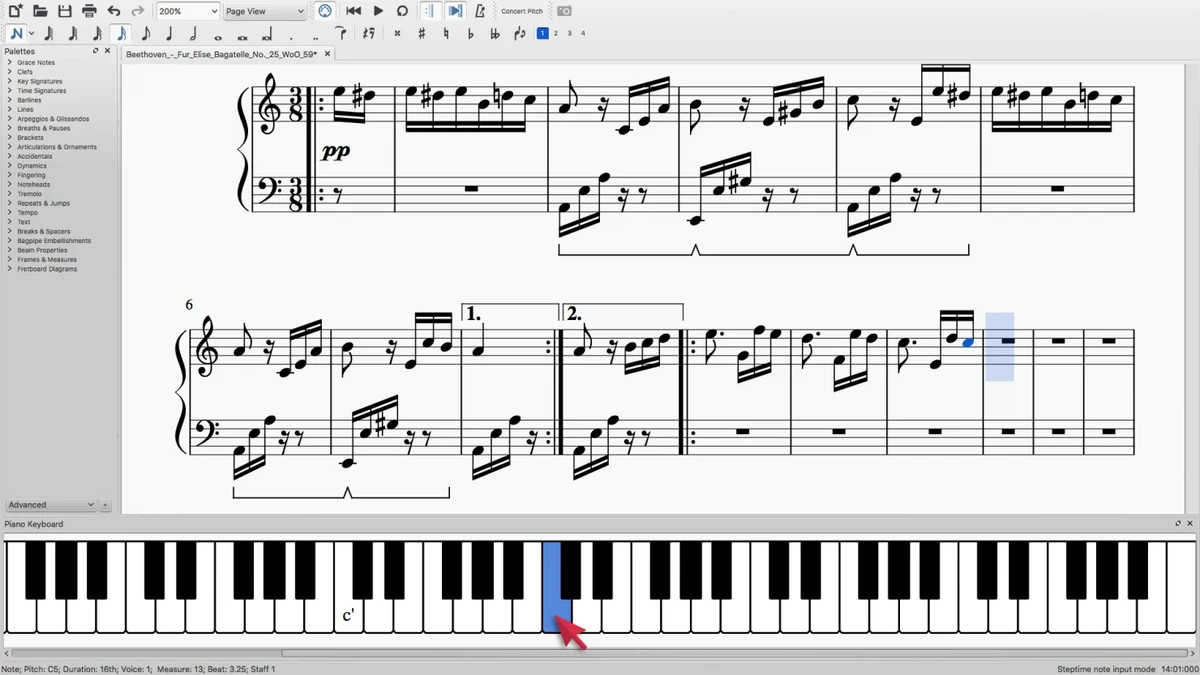

MuseScore is a free and open-source music notation application designed for composers, musicians, students, and educators who need to create professional-looking sheet music. The software allows users to write, edit, print, and share musical scores with support for unlimited staves and up to four voices per staff. It includes tools for creating music for piano, guitar, orchestra, jazz, choir, marching bands, and many other arrangements. MuseScore supports importing and exporting MIDI and MusicXML files, exporting scores as PDF or WAV files, and sharing compositions online. With its visual note sheet interface, MIDI keyboard support, and built-in playback tools, MuseScore provides a complete environment for writing and reviewing musical compositions.
Features of MuseScore
- WYSIWYG music notation interface with a virtual note sheet.
- Create scores with unlimited numbers of staves.
- Support for up to four voices per staff.
- Write music using keyboard, mouse, or MIDI keyboard input.
- Supports dynamics, articulations, lyrics, chords, and lead sheet notation.
- Integrated sequencer and FluidSynth software synthesizer.
- Import and export support for MusicXML and Standard MIDI Files.
- Export scores to PDF and WAV formats.
- Supports online score sharing.
- Available for Windows, macOS, and Linux.
- Available in 43 languages.
- Licensed under the GNU GPL open-source license.
Interface and Usability
MuseScore provides a visual editing experience where users create music directly on a virtual sheet. The WYSIWYG approach makes it easier to see how a finished score will appear while composing. Adding instruments is straightforward, allowing users to select instruments and include them in a score with a simple action. The software supports multiple input methods, including keyboard, mouse, and MIDI keyboard, giving musicians flexibility depending on their preferred workflow. The integrated playback features also allow users to listen to their compositions while editing.
While MuseScore offers many professional-level notation options, beginners may need time to learn the available tools and score creation workflow. However, the structured interface and extensive notation support make it suitable for both learning and advanced composition.
Who Should Use MuseScore?
- Composers writing original music arrangements.
- Music students learning notation and composition.
- Teachers creating musical exercises and teaching materials.
- Musicians preparing scores for performances.
- Users looking for a free alternative to paid notation software.
Conclusion
MuseScore is a capable and accessible music notation solution for anyone who wants to create digital sheet music without paying for expensive software. Its combination of professional notation features, MIDI support, playback tools, and open-source availability makes it a strong choice for composers, students, and musicians.


