


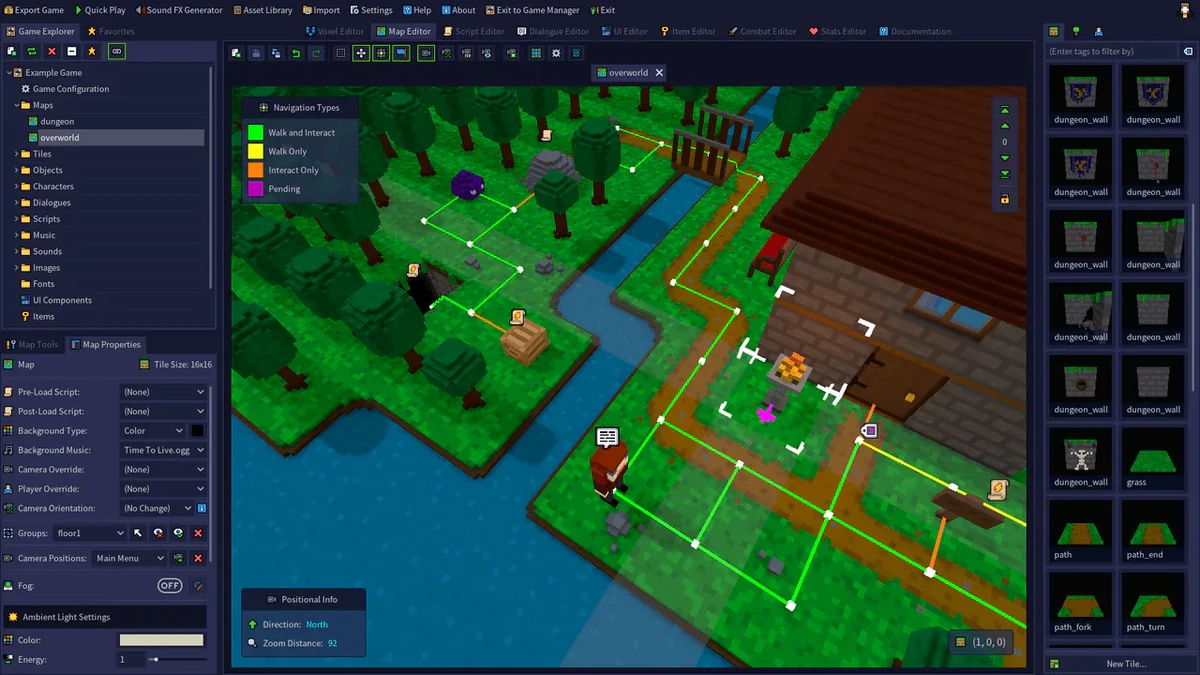

Godot Game Engine is a free and open-source game development platform that enables developers to create both 2D and 3D games within a unified development environment. Designed to simplify the game creation process without limiting flexibility, it provides a comprehensive set of built-in tools that allow developers to focus on designing gameplay, building levels, and creating interactive experiences instead of assembling multiple third-party solutions.
At the heart of Godot is its node-based architecture, which allows games to be built from reusable components that can be combined into flexible scenes. Developers can use hundreds of built-in nodes or create custom ones to implement unique behaviors and workflows. The engine also includes a visual editor with a clean, context-sensitive interface that helps streamline development for programmers, artists, designers, and animators alike.
Godot supports the complete game production pipeline with tools for scene creation, animation, level design, and content management. Live editing allows many changes to remain available while testing projects, making iteration faster during development. Once a project is complete, it can be exported to a wide range of platforms, including Windows, macOS, Linux, Android, iOS, HTML5, and other supported environments. Its open-source license and active community have made Godot a popular choice for indie developers, students, and professional game creators.
Features of Godot Game Engine
- Free and open-source game engine
- Unified environment for 2D and 3D game development
- Node-based development system
- Flexible scene composition with instancing and inheritance
- Hundreds of built-in nodes
- Create custom nodes, tools, and editors
- Visual, context-sensitive editor
- Integrated content creation pipeline
- Live editing during development
- Cross-platform project export
- Support for Windows, macOS, Linux, Android, iOS, and HTML5
- Support for VR and AR platforms
- Suitable for artists, designers, animators, and programmers
Interface and Usability
Godot features a clean and well-organized interface that keeps development tools accessible without overwhelming new users. The visual editor groups commonly used tools into logical workspaces, making it easy to switch between scene editing, animation, scripting, and project management.
The engine's node and scene system simplifies project organization by encouraging reusable components and modular design. Developers can build complex scenes by combining smaller elements instead of creating everything from scratch. Live editing further improves productivity by allowing many changes to remain available during testing, reducing repetitive setup during development. Although beginners will need time to understand concepts such as nodes and scenes, the interface remains approachable compared with many professional game engines.
Who Should Use Godot Game Engine?
- Indie game developers
- Professional game studios
- Students learning game development
- Developers creating 2D games
- Developers building 3D projects
- Artists and level designers
- Educators teaching game design
- Anyone looking for a free, open-source game engine
Conclusion
Godot Game Engine delivers a complete game development environment without licensing costs, making it one of the strongest open-source alternatives available today. Its combination of a flexible node-based architecture, visual editor, integrated production tools, and broad platform support allows developers to create everything from simple 2D projects to complex 3D games within a single application. The active community and open-source development model also ensure continuous improvements and long-term accessibility.


