


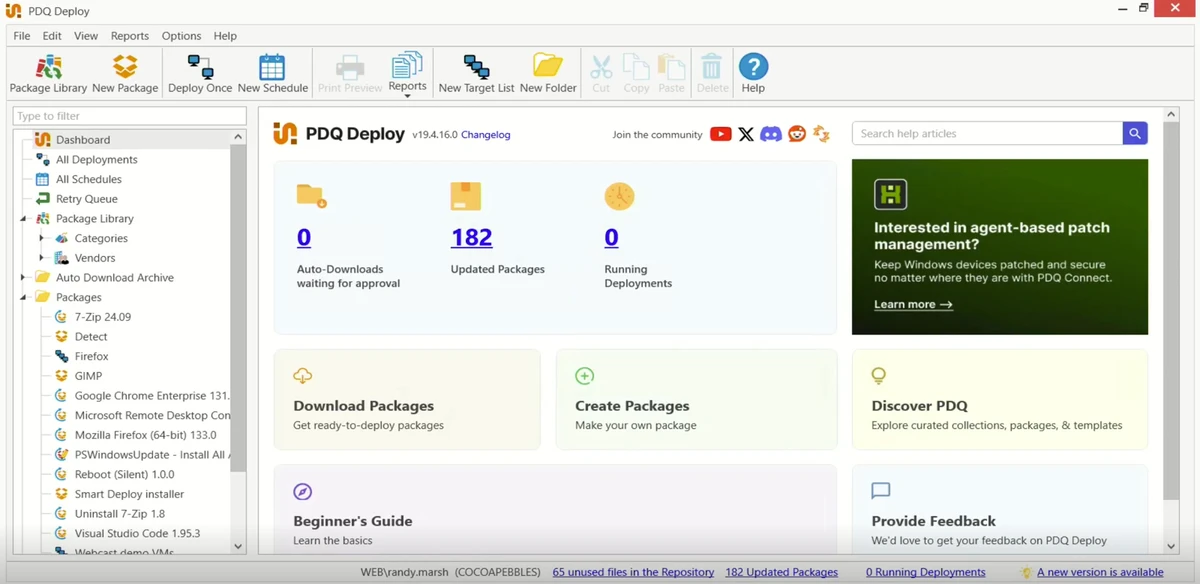

PDQ Deploy is a Windows software deployment solution built for IT administrators who need an efficient way to install applications, deploy updates, and automate maintenance across multiple computers. Instead of manually visiting each machine, I found that PDQ Deploy centralizes deployment tasks from a single console, making routine software management significantly more manageable.
The software supports silent deployment of both .exe and .msi installers, allowing administrators to install, uninstall, execute scripts, reboot systems, copy files, and perform other deployment tasks remotely. When paired with PDQ Inventory, it can automatically deploy scheduled updates—even when target computers come online after being offline—helping ensure systems remain up to date with minimal manual intervention.
Another standout aspect is its maintained library of more than 175 ready-to-deploy applications, reducing the time spent packaging common software updates. Combined with deployment scheduling, email notifications, and shared administration capabilities, PDQ Deploy is designed to streamline Windows software management for IT teams.
Features of PDQ Deploy
- Deploy almost any Windows application or patch using .exe and .msi installers.
- Silently install or uninstall software across multiple Windows PCs simultaneously.
- Execute deployment tasks including:
- Running scripts
- Copying files
- Rebooting systems
- Sending messages
- Sleeping devices
- Schedule deployments to automate routine software updates.
- Integrates with PDQ Inventory to deploy updates when offline computers reconnect.
- Execute .vbs, .reg, .bat, and .ps1 scripts from existing files or create them directly.
- Access a maintained library of over 175 ready-to-deploy applications.
- Receive email notifications when deployments or scheduled tasks complete.
- Support multi-admin environments through a shared database.
- Initiate deployments from either the graphical console or the Command Line Interface (CLI).
Interface and Usability
From an IT administrator's perspective, PDQ Deploy focuses on productivity rather than visual complexity. The management console keeps deployment tasks centralized, making it straightforward to organize software packages, schedules, and deployment history. The workflow is logical: create or select a deployment package, choose target computers, configure deployment options, and execute or schedule the task. Administrators who regularly work with PowerShell or Windows scripting will also appreciate the built-in ability to deploy common script formats without relying on separate tools.
For larger teams, the shared database helps multiple administrators work from the same deployment environment, reducing duplicated effort and keeping deployment configurations synchronized.
Who Should Use PDQ Deploy?
- IT administrators managing multiple Windows computers
- System administrators responsible for software deployment
- Managed service providers (MSPs)
- Corporate IT departments
- Organizations looking to automate Windows application updates
- Teams that regularly deploy PowerShell or Windows scripts
Conclusion
PDQ Deploy is a practical solution for Windows software deployment and patch management. During evaluation, its strongest advantages were centralized deployment, scheduling automation, scripting support, and the maintained application library that reduces repetitive packaging work.


