


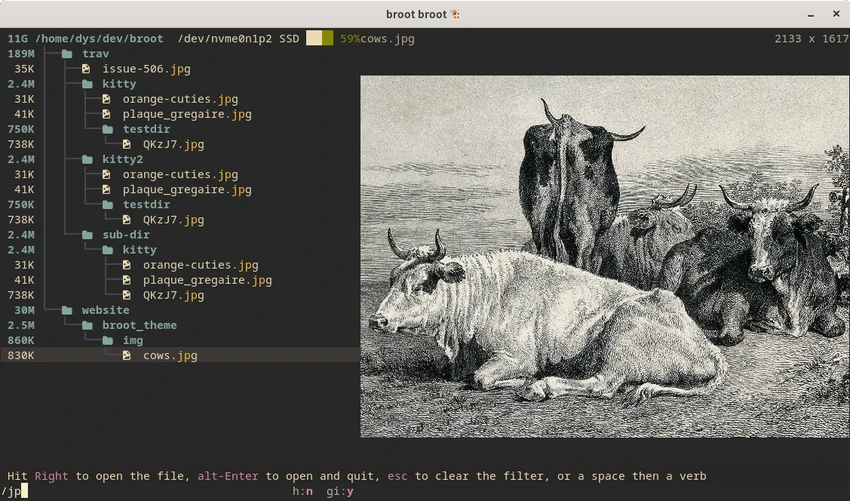

Broot is an open-source command-line file manager designed to simplify filesystem navigation through an interactive tree-based interface. Built for users who spend significant time working in the terminal, it replaces the traditional workflow of switching between commands like ls, cd, and find with a live, searchable directory tree that updates as you type.
The application emphasizes speed and minimalism, allowing users to navigate large directory structures with fewer keystrokes. Its interactive interface makes it easier to locate files and folders, even when you do not remember their exact locations. Searches remain responsive, and ongoing searches can be interrupted immediately as new queries are entered, helping maintain a smooth workflow even on large storage devices.
Beyond navigation, Broot provides essential file management capabilities, including searching for files, performing basic file operations, and attaching custom keyboard shortcuts. It also displays detailed file information such as size, modification date, and permissions, while allowing users to copy file paths directly to the clipboard for use in other applications.
Broot supports Windows, macOS, and Linux, making it a versatile tool for developers, system administrators, and terminal enthusiasts. To enable full navigation functionality, the application requires a shell function (br) to be configured. With its lightweight design and focus on efficient terminal workflows, Broot offers a practical alternative to traditional command-line file navigation.
Features of Broot
- Interactive tree-based file navigation
- Live file and folder search
- Fast navigation with minimal keystrokes
- Responsive searching for large directories
- Custom keyboard shortcuts
- Customizable color themes
- Basic file operations
- Display file size, permissions, and modification dates
- Copy file paths to the clipboard
- Cross-platform support for Windows, macOS, and Linux
- Open-source project
- Designed for terminal-based workflows
Interface and Usability
Broot replaces traditional command-line navigation with an interactive tree view that updates in real time as you type. Instead of repeatedly entering directory commands, users can quickly browse folder structures and jump directly to the files they need.
The interface is intentionally minimal, reducing unnecessary complexity while providing quick access to navigation and search functions. Keyboard-driven controls make it efficient for terminal users, and customizable shortcuts allow users to adapt the workflow to their preferences. Although Broot is easy to use once configured, new users should expect to spend some time learning its commands and setting up the required shell integration for the best experience.
Who Should Use Broot?
- Developers working primarily in the terminal
- Linux, macOS, and Windows power users
- System administrators
- Users who frequently navigate large directory structures
- Anyone looking for a faster command-line file manager
Conclusion
Broot is an excellent choice for users who spend most of their time working in the terminal and want a faster way to navigate the filesystem. Its live tree view, responsive search, and keyboard-focused workflow reduce the need for repetitive shell commands while keeping the interface lightweight and efficient. Although it requires some initial setup and familiarity with terminal workflows, Broot rewards regular users with a streamlined navigation experience. If you're looking for a modern command-line file manager that improves productivity without unnecessary complexity, Broot is well worth trying.


