


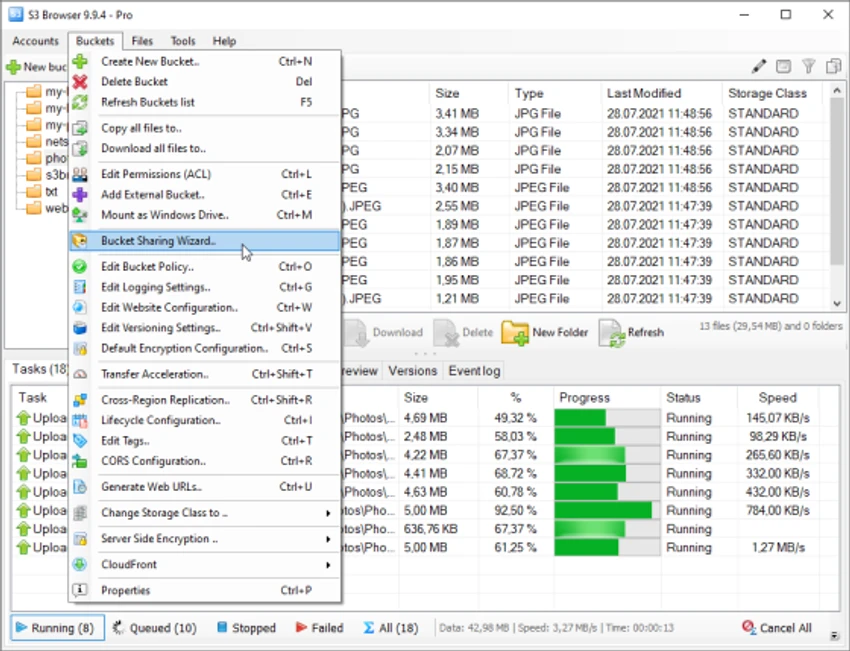

S3 Browser is a Windows-based client designed for managing Amazon S3 and Amazon CloudFront services. It provides a graphical interface for interacting with cloud storage, allowing users to upload, download, organize, and control files stored in Amazon S3 buckets. In practical use, S3 Browser simplifies cloud storage management by replacing command-line AWS operations with a structured desktop interface. It is especially useful for users who regularly work with large-scale data storage, backups, or content distribution workflows through CloudFront.
From my evaluation of its capabilities, the software focuses heavily on making cloud operations more accessible—whether you're managing a few buckets or working with millions of files in enterprise environments.
Features of S3 Browser
- Upload and download files to and from Amazon S3.
- Create, browse, and delete S3 buckets.
- Share buckets with other Amazon S3 users.
- Access buckets shared by other users.
- Manage Amazon CloudFront distributions.
- Support for multiple Amazon S3 accounts and S3-compatible storage providers.
- Client-side encryption (AES-256) and compression.
- High-speed multipart upload and download with pause/resume support.
- Support for Amazon S3 versioning and version management.
- Sync folders with “upload only new or changed files” option.
- Full support for AWS Identity and Access Management (IAM).
- Server-side encryption and secure transfer options.
- Bucket policies, lifecycle rules, and access control management.
- Support for large files up to 5 TB.
- Command-line tools for automation.
- Bandwidth throttling and proxy support.
- Drag-and-drop file transfers from Windows Explorer.
- CloudFront distribution management tools.
- Support for static website hosting on S3.
- Cross-account file copy and move operations.
Interface and Usability
S3 Browser provides a structured, Windows-style interface centered around S3 buckets, making cloud storage feel more like local file management. The ribbon-style toolbar groups essential actions such as upload, permissions, and bucket management in a way that is easy to access.
During use, I found the tabbed layout particularly helpful when working across multiple buckets or tasks simultaneously. Features like drag-and-drop uploads and folder synchronization reduce friction for everyday operations, while more advanced tools—such as IAM and policy management—remain accessible without overwhelming the interface. Although it offers enterprise-grade functionality, the software maintains a relatively approachable workflow, especially for users familiar with Windows file managers.
Who Should Use S3 Browser?
S3 Browser is well suited for:
- AWS developers and system administrators
- DevOps engineers managing cloud infrastructure
- Businesses using Amazon S3 for backups or storage
- Content delivery teams using CloudFront
- Users who prefer GUI-based cloud management over AWS CLI
- Organizations managing large-scale file storage systems
Conclusion
S3 Browser is a powerful and practical tool for managing Amazon S3 and CloudFront services from a Windows desktop environment. It replaces complex cloud operations with a user-friendly interface while still supporting advanced AWS features like IAM, encryption, and lifecycle policies.


