


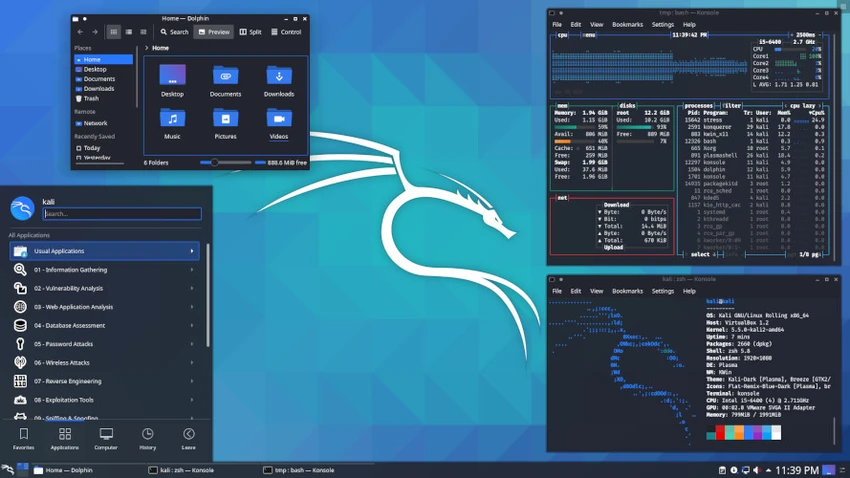

Kali Linux is a security-focused operating system designed for penetration testing, digital forensics, and cybersecurity research. It comes preloaded with a wide range of tools used to test network security, analyze vulnerabilities, and perform ethical hacking tasks. Originally built as a live DVD environment, Kali Linux has evolved into a full-featured operating system widely used by cybersecurity professionals, researchers, and ethical hackers. It can be run from a hard drive, live USB, or virtual environment, making it flexible for both permanent installation and portable use.
Features of Kali Linux
- Preinstalled penetration testing tools and utilities
- Network scanning and port analysis (e.g., Nmap)
- Packet analysis and network monitoring (e.g., Wireshark)
- Password cracking and recovery tools (e.g., John the Ripper)
- Wireless network auditing tools (e.g., Aircrack-ng)
- Reverse engineering and binary analysis tools
- Digital forensics toolset for investigation and evidence analysis
- Supports live boot via USB, DVD, or hard drive installation
- Extensive toolkit for vulnerability assessment and exploitation testing
- Regular updates with new cybersecurity tools and patches
- Designed for both offensive and defensive security testing
User Experience
During my experience with Kali Linux, the operating system proved to be a highly specialized environment tailored for cybersecurity professionals. Unlike standard desktop operating systems, Kali is built around a toolkit-first approach, where nearly every preinstalled application serves a specific security or networking purpose.
The included tools such as Nmap for network scanning, Wireshark for packet inspection, and Aircrack-ng for wireless security testing provide a comprehensive suite for analyzing system vulnerabilities. Each tool is deeply integrated into the ecosystem, allowing users to move between reconnaissance, analysis, and exploitation workflows efficiently. The live boot capability is particularly useful for penetration testers who need a portable and non-intrusive environment. Running Kali from a USB drive allows users to perform security assessments without modifying the host system.
However, the system is not designed for casual users. Its interface and toolset assume a strong understanding of Linux systems, networking, and cybersecurity principles. For beginners, there is a significant learning curve. Despite this, Kali Linux remains one of the most complete and widely respected platforms for ethical hacking and security testing.
Who Should Use Kali Linux?
- Cybersecurity professionals
- Ethical hackers and penetration testers
- Network administrators and security analysts
- Digital forensic investigators
- Students learning cybersecurity and networking
- Researchers in information security
Conclusion
Kali Linux is a complete cybersecurity operating system designed for advanced security testing and analysis. With its extensive collection of penetration testing tools, it provides everything needed for vulnerability assessment and ethical hacking.


